Kayhan: The time has come for America to leave West Asia
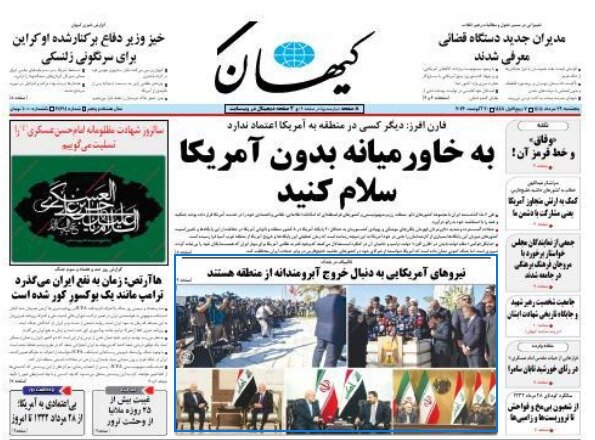
Kayhan, in an article, points to the desperation of the United States in its war with Iran. Six months have passed since the US and Israel launched their war against Iran, but Iran fought not only the United States but also NATO members, regional states, and Israel, and forced them all to their knees through steadfast resistance.
Experts argue that Iran fought two nuclear powers without fear, and in the midst of this conflict a new deterrent capability emerged for Iran. By closing the Strait of Hormuz — and causing severe economic shock to the US and the global economy — Iran demonstrated both the ability and the will to shut the strait. Iran’s extensive missile and drone attacks on at least 20 US bases in eight regional countries, combined with Washington’s inability to protect these bases or ensure the security of their host nations, have led many analysts, including some inside the United States, to conclude that the time has come to shut down these bases and withdraw US forces from West Asia.
Iran: Avoiding extremist interpretations of the Caspian Convention
The Iran newspaper analyzes the legal status of the Caspian Sea, Iran’s position within this body of water, and the signing of the Caspian Convention. Iran’s power and interests in the Caspian Sea do not stem solely from legal frameworks or international treaties. Rather, Iran’s true value lies in its geographic position — a position that can become geopolitical power only through infrastructure development, strengthened transport corridors, active participation in Central Asia, Caucasus, and Eurasian routes, and an energetic diplomatic strategy. Both the “50 percent share for Iran view and, conversely, the 9 percent share” view are forms of extremism that ignore the mechanisms outlined in the convention. Therefore, the issue must be examined precisely and based on legal and security considerations, without falling into either extreme. Ultimately, Iran must consider three elements simultaneously — law, power, and timing — and understand their interdependence to make optimal use of existing opportunities and secure its national interests.
************Ettelaat: Trump claims he has launched an economic war against Iran
Ettelaat reviews Trump’s latest claim. Trump — having failed on the military front and now under pressure from global and domestic public opinion — has adopted a hostile anti‑Iranian stance and declared the start of an economic war. Trump’s contradictory behavior shows he is trying to construct a narrative of victory for himself after an unjustified attack on Iran. This approach has deepened Tehran’s distrust and reinforced Washington’s repeated pattern of avoiding commitments in signed agreements. Washington’s efforts to portray Iran as weakened economically or militarily, followed by attempts to create hope that Iran might accept an unequal agreement, are described as a miscalculation — one that Iranian officials have repeatedly rejected.
Javan: Iran’s symmetric response in Hormuz and Bab al‑Mandab
Javan discusses Iran’s coordination with its regional allies and a strategic defeat for the United States. Iran and its partners, with a precise understanding of the new battlefield, delivered a symmetric — and even superior — response. Iran, in strategic coordination with the Houthis, first sought to bring the Strait of Hormuz fully under its control. Then, it contributed to further restricting and nearly closing Bab al‑Mandab. As a result, two critical chokepoints of global energy and trade were simultaneously placed under pressure. This action increased economic and political costs for the US and its allies. By targeting the same type of strategic assets that the US had focused on — production, supply, and transport chains — Iran delivered a proportionate and deterrent response. What has unfolded in recent weeks is not a series of isolated incidents but a coherent and predictable pattern of conflict in which both sides are operating within a single battlefield: the battlefield of strategic supply chains.
Shargh: Disruption in Iran–UAE trade and economic relations
Shargh analyzes the suspension of the UAE’s trade exchanges with Iran. The flames of war in the Persian Gulf have engulfed two major trading partners. After the conflict, the UAE has run into the hard barrier of the Strait of Hormuz in exporting its oil and is experiencing a downturn in its tourism industry. Meanwhile, Iran is facing strained relations with one of its largest commercial partners. The war has driven the two neighboring trade partners apart to the point that Iran has barred Emirati oil tankers from passing through the Strait of Hormuz, and the UAE has explicitly announced that all trade and financial transactions with Iran are suspended until further notice. The political and economic interests of neighboring states are deeply intertwined, and neither side can easily deny this reality. Therefore, both countries must reconsider their relationship and create conditions for peace and reconciliation.
Leave a Comment